
Metrics are fragmented
Delivery, repositories, CI/CD, incidents, and AI tooling live across different systems, making it difficult to see the full picture.
Turn fragmented engineering data into decision-quality intelligence.
Your delivery, repositories, CI/CD, incidents, AI tooling, and engineering workflows generate valuable signals, but they often live in disconnected systems.
We connect those signals to reveal where engineering performance is constrained, what is driving it, and which improvements should come first.
Engineering organizations generate enormous amounts of delivery and operational data. The challenge is knowing what it means, and what to do about it.
Delivery, repositories, CI/CD, incidents, and AI tooling live across different systems, making it difficult to see the full picture.
Problems often become visible only after delivery slows down, timelines slip, or quality suffers.
Different teams can measure performance differently, making meaningful comparison and improvement difficult.
Numbers can tell you what happened without explaining where time is being lost or what is driving the problem.
Without a connected view of engineering performance, teams can spend time fixing symptoms instead of addressing the underlying constraint.
Instead of looking at engineering performance through isolated metrics, we connect the signals that matter.
Are we fast and stable?
Deployment frequency · Lead time · Change failure · Recovery
Where is time being lost?
PR cycle time · Review latency · Queue time · WIP · Throughput
What is helping or slowing the codebase?
Rework · Defects · CI health · Code health · Architecture friction
Does the improvement actually matter?
Predictability · Customer value · Platform leverage · AI-enabled productivity
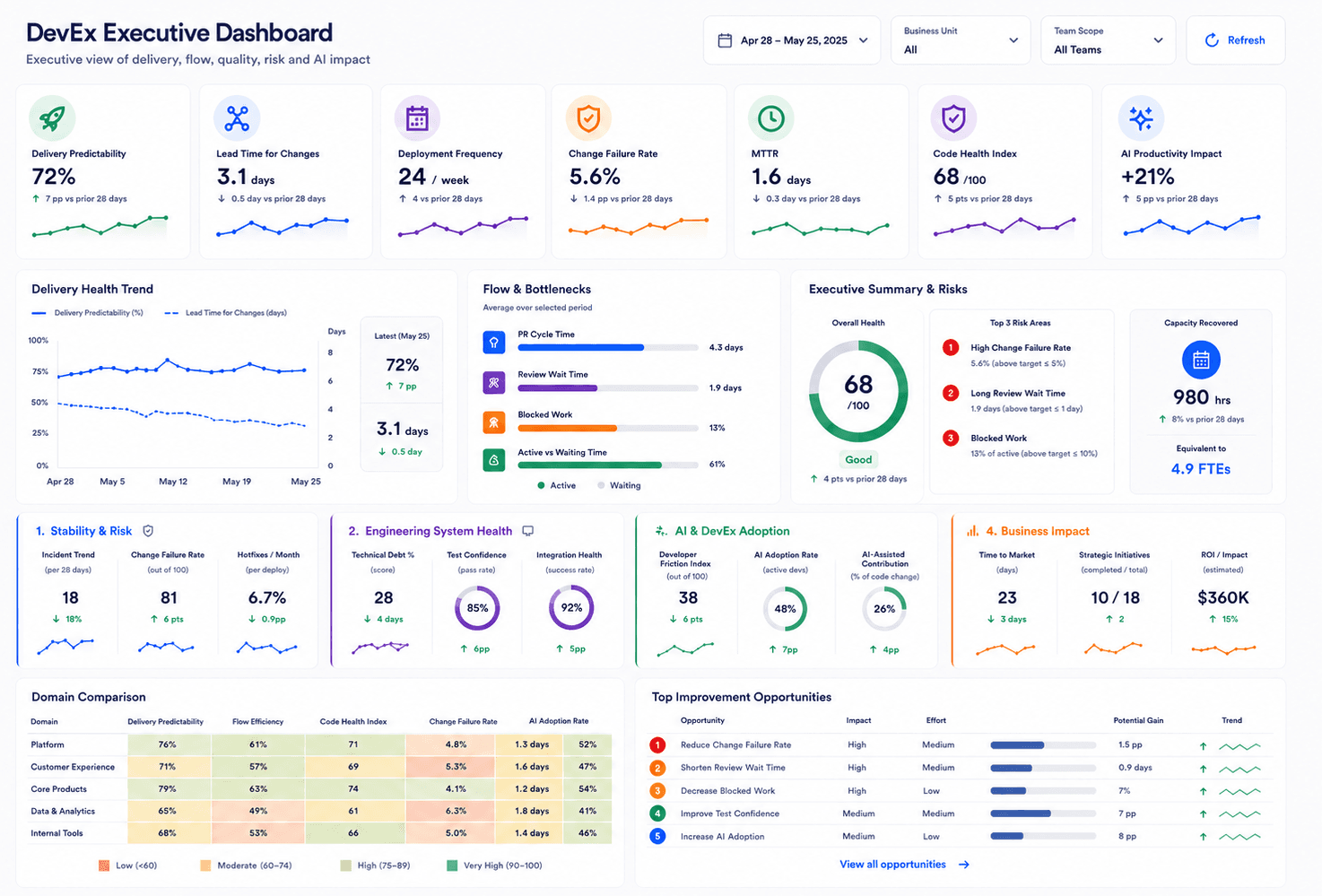
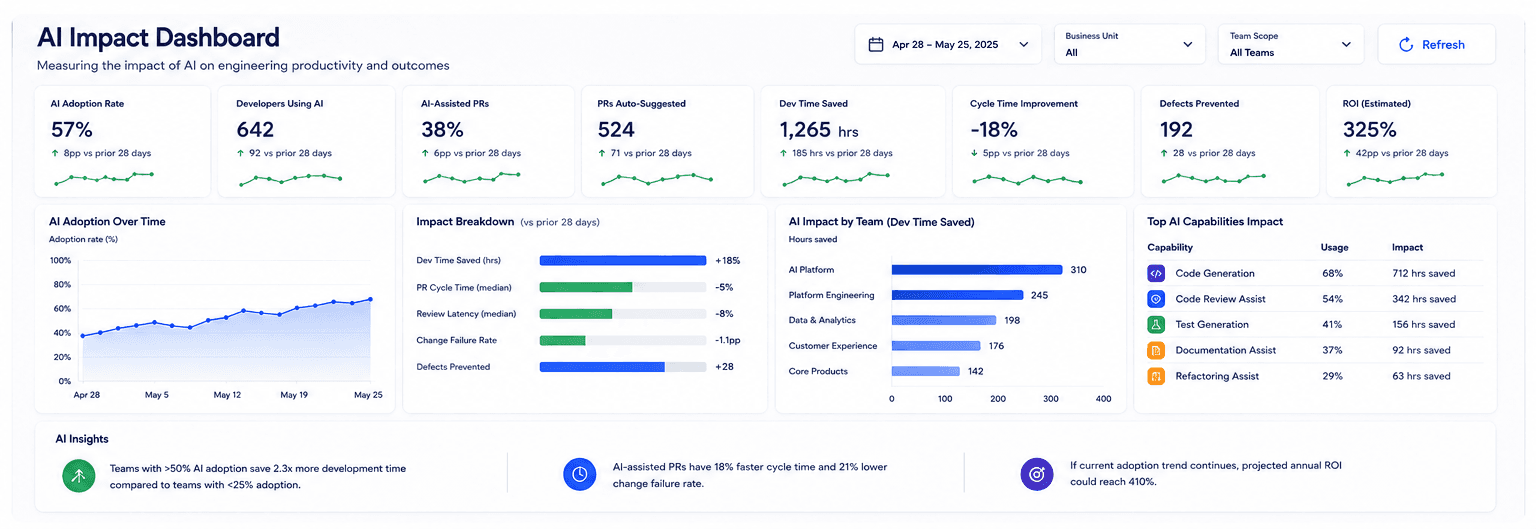
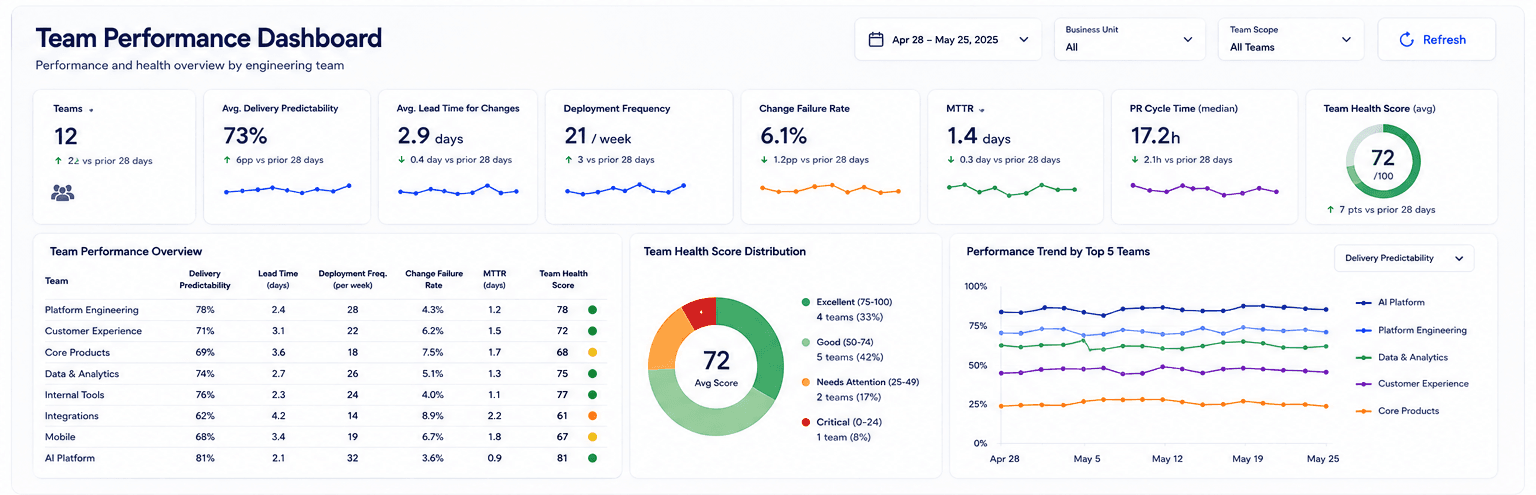
The result is a connected view of engineering performance, from operational signals to business impact.
Every engagement follows a disciplined path from fragmented data to actionable engineering decisions.
We map your teams, repositories, workflows, source systems, and existing metrics to understand your current engineering landscape.
We define reliable sources of truth, connect relevant systems, normalize the data, and build the measurement and visualization layer.
We correlate signals across delivery, flow, quality, DevEx, and AI to uncover bottlenecks, risks, trends, and improvement opportunities.
We prioritize recommendations, define improvement actions, and establish a way to track whether those changes are delivering results.
Engineering Intelligence goes beyond reporting metrics. It connects signals to the questions leaders actually need to answer.
A team may appear busy while significant time is being consumed by review queues, waiting, handoffs, or work in progress.
Why it Matters
Without visibility into flow, teams can focus on increasing activity while the underlying constraint remains.
What Intelligence Reveals
Correlated flow signals can identify where work is waiting, where delivery is slowing, and which part of the workflow deserves attention first.
AI usage alone does not demonstrate engineering leverage.
Why it Matters
Engineering leaders need to understand whether increased AI adoption is changing throughput, quality, delivery, or other meaningful performance signals.
What Intelligence Reveals
AI adoption and spending can be connected with engineering flow and quality signals to establish measurable hypotheses about AI impact.
Illustrative examples only. Results depend on the organization's data and context.
Every engagement produces a connected set of outputs designed to support leadership decisions and engineering improvement.
Documented sources of truth, definitions, and calculation logic for consistent measurement.
A high-level view of engineering performance, trends, constraints, and improvement signals.
Detailed delivery, flow, quality, and AI signals that help teams understand their own operating environment.
A clear view of bottlenecks, risks, trends, and improvement opportunities.
Improvement actions organized around what should be addressed first.
A practical path from baseline and insight to prioritized action and continuous tracking.

Engineering Intelligence turns measurement into a business capability, not just a reporting function.
Understand lead time, throughput, and delivery trends to make planning and forecasting more informed.
See where waiting, review delays, WIP, handoffs, and workflow friction are affecting delivery.
Identify rework, defects, CI/CD health, and other signals that can affect engineering effectiveness.
Understand which engineering improvement opportunities deserve attention and resources.
Go beyond AI adoption metrics to understand whether AI is changing engineering performance.
Track trends and impact over time instead of treating improvement as a one-time initiative.
Typical indication for organizations with a focused engineering environment; scope and investment vary based on size, teams, data complexity, and objectives.
Map teams, repositories, workflows, source systems, and existing dashboards.
Define sources of truth, normalize key metrics, and establish the baseline.
Correlate signals to identify bottlenecks, risks, trends, and opportunities.
Deliver recommendations, executive readout, and the next-quarter improvement plan.