

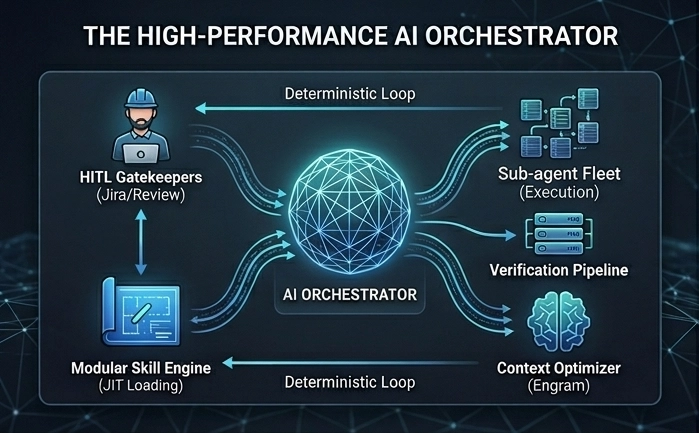
As AI-assisted software development becomes increasingly common, engineering teams face a growing challenge: how do you maintain code quality, architectural consistency, and predictable delivery when large language models (LLMs) are generating significant portions of your codebase?
At Blue Trail Software, we believe high-performance AI development is not about generating more code faster. It is about building deterministic AI engineering workflows that maximize quality, reduce waste, and preserve human oversight.
This is the foundation of our High-Performance AI Protocol — a structured AI software development framework designed to improve delivery speed, reduce token costs, and increase reliability across the entire engineering lifecycle.
Why Deterministic AI Output Matters in Software Engineering
AI coding tools can accelerate implementation dramatically, but without structured workflows they often introduce:
Inconsistent architectural decisions
Hallucinated dependencies
Poor context awareness
Token inefficiency
Technical debt accumulation
Unpredictable output quality
This creates a critical engineering challenge: speed without determinism creates fragility.
The solution is not less AI. The solution is better orchestration.
At Blue Trail Software, we treat AI as an execution layer inside a deterministic software engineering system — not as an autonomous decision-maker.
The AI Development Pipeline: Human-Supervised Orchestration
Our AI development lifecycle operates as a structured orchestration model built around four core phases:
1. Definition (Human-in-the-Loop)
Everything starts with a clear task definition.
Engineers create the Single Source of Truth inside Jira, documenting:
Scope
Requirements
Constraints
Dependencies
Acceptance criteria
This eliminates ambiguity before any AI system begins generating code.
In AI-assisted development, poor input creates poor architecture. Clear task definition is the first quality gate.
2. Architecture (Plan Validation)
Before implementation begins, we validate architecture. This phase includes:
Reviewing technical design
Breaking work into atomic tasks
Identifying dependencies
Validating risk areas
Defining implementation boundaries
This prevents expensive downstream debugging. Planning-level iteration is significantly cheaper than code-level rework.
3. Execution (Sub-Agent Delegation)
Implementation is delegated to specialized AI sub-agents. Rather than relying on a single large context model, specialized sub-agents handle:
Backend logic
Frontend implementation
Database migrations
API integrations
Testing
This modular execution model improves:
Performance
Token efficiency
Context isolation
Code consistency
4. Delivery (Automated Validation)
The final stage includes:
Automated tests
Continuous integration (CI)
Pull request generation
Team notifications
Final peer review
Every delivery stage includes validation evidence. AI-generated code must prove correctness before shipping.
Human-in-the-Loop (HITL): The Core of Reliable AI Development
One of the biggest misconceptions in AI engineering is that automation replaces technical judgment.
It does not. Human-in-the-loop (HITL) remains essential for deterministic AI software delivery.
There are two critical intervention points:
Task Definition and Context Control
Before AI generates anything, engineers establish:
Business logic boundaries
Technical expectations
Existing system constraints
Integration points
This ensures the AI operates within defined architectural reality.
Plan Review Before Code Generation
Before execution begins, engineers review the implementation plan.
This creates an early validation checkpoint where flaws are caught before token-heavy code generation starts. This dramatically improves:
Development speed
Code quality
Architectural consistency
Token cost efficiency
Spec-Driven Development (SDD) for Complex AI Tasks
For ambiguous or high-complexity tasks, we apply Spec-Driven Development (SDD).
SDD forces the AI to produce a technical blueprint before writing code. This blueprint includes:
System architecture
Dependency mapping
Implementation logic
Atomic task decomposition
Edge-case considerations
This allows engineers to validate logic at the specification layer.
Benefits of Spec-Driven Development:
Reduced hallucinations
Better architecture alignment
Faster debugging
Improved code predictability
Lower rework costs
For simple tasks, we skip SDD and move directly into streamlined execution. This creates dynamic efficiency based on complexity.
Modular AI Skill Orchestration
To maintain performance, we use modular skill loading instead of permanent context injection. This means AI capabilities are loaded only when required.
Just-in-Time (JIT) Context Loading
Skills activate dynamically based on task intent:
Jira → ticket parsing
GitHub → pull requests
Slack → team communication
Testing → validation workflows
This reduces unnecessary token overhead.
Four Core AI Skill Categories
Our protocol separates capabilities into:
Definition Skills
Task scoping, Jira parsing, requirement extraction.
Architecture Skills
Specification generation, design validation, dependency analysis.
Execution Skills
Implementation, refactoring, debt management.
Delivery Skills
Testing, pull requests, CI pipelines, notifications.
This modular orchestration improves scalability and lowers cost.
Token Efficiency in AI Software Development
One of the biggest hidden costs in AI-assisted development is token waste. Our protocol prioritizes planning efficiency over implementation waste.
Example:
Refining an architecture plan may consume 500 tokens.
Fixing a failed implementation may consume 5,000+ tokens.
This creates a simple engineering principle:
Blueprint iteration is always cheaper than implementation rollback.

This approach reduces:
API costs
Developer rework
Failed deployments
Context pollution
Context Management for High-Performance AI Workflows
Efficient context management is essential for large-scale AI engineering. Our protocol applies three deterministic optimization layers:
Strategic Sub-Agent Delegation
Repetitive tasks are delegated:
Merge conflict parsing
Pull request summaries
Documentation generation
This reduces output token usage by 50–70%.
Compact Rule Injection
Instead of injecting full documentation, we provide compressed rule blocks. This reduces input token load significantly.
Long-Term Memory Persistence
Using vector embeddings and semantic retrieval, we dynamically fetch only relevant historical code context.
This keeps the active context window below 20% utilization. This improves:
Response quality
Speed
Cost control
Context precision
The 13-Step AI Engineering Lifecycle
Our AI protocol follows a strict 13-step software delivery lifecycle:
Jira ticket selection
Branch creation
Context synchronization
Spec initialization
Task decomposition
AI implementation
Documentation updates
Conventional commits
Automated testing
Pull request creation
Merge conflict resolution
Team notifications
Final peer review

This ensures:
Full traceability
Consistent quality
Faster reviews
Reliable deployments
If pull request comments require changes, the process loops back into planning. This preserves deterministic quality control.
Benefits of a Deterministic AI Engineering Workflow
Implementing a structured AI software development protocol delivers measurable benefits:
Faster development cycles
Lower token costs
Reduced technical debt
Higher code consistency
Better architectural alignment
Stronger test coverage
Improved team collaboration
Higher deployment confidence
Most importantly, it transforms AI from a risky accelerator into a controlled engineering multiplier.
Final Thoughts: AI Should Multiply Engineering, Not Replace It
The future of software development is not about removing engineers from the process. It is about increasing engineering leverage.
The strongest AI development teams will not be the ones generating the most code. They will be the ones building the best systems around AI:
Clear specifications
Human validation
Modular orchestration
Deterministic workflows
Continuous testing
Efficient context management
At Blue Trail Software, this protocol allows us to scale AI-assisted software development while maintaining engineering quality, operational efficiency, and long-term sustainability.
Because in modern engineering, predictability is the real performance multiplier.

