

Pull requests are getting larger, harder to review, or slower to approve.
Can your team verify AI generated code fast enough?
AI-assisted development can dramatically increase the amount of code a team can produce.
If pull requests take longer to review, CI pipelines generate more noise, regression cycles expand, or engineers spend more time validating AI-generated changes, the bottleneck hasn't disappeared. It has moved downstream.
And that can create a dangerous gap.
Is your engineering team seeing any of these?
AI-assisted development is increasing, but release speed or predictability isn't improving.
Your test suite is growing, but you're not sure whether it is catching the defects that matter.
Flaky tests, regression, environment issues, or defect triage are repeatedly delaying releases.
Leadership cannot clearly connect AI adoption with verification effort, rework, stability, or delivery outcomes.
If any of these sound familiar, the problem may not be AI productivity. It may be your ability to verify what AI is producing.
Read The AI Verification Gap Report
An engineering research for technology leaders navigating AI-assisted development.
AI changes the economics of software development. Your verification system has to change with it.
AI can accelerate implementation. But verification still has to answer the same fundamental question:
Can we trust this change enough to deliver it?
That answer depends on how efficiently changes move through:
Development (+ unit tests) → CI Quality Gates → Code Review → Integration/E2E Testing → Release Gate → Release
A weakness anywhere in that chain can create waiting, rework, false confidence, or delayed release decisions.
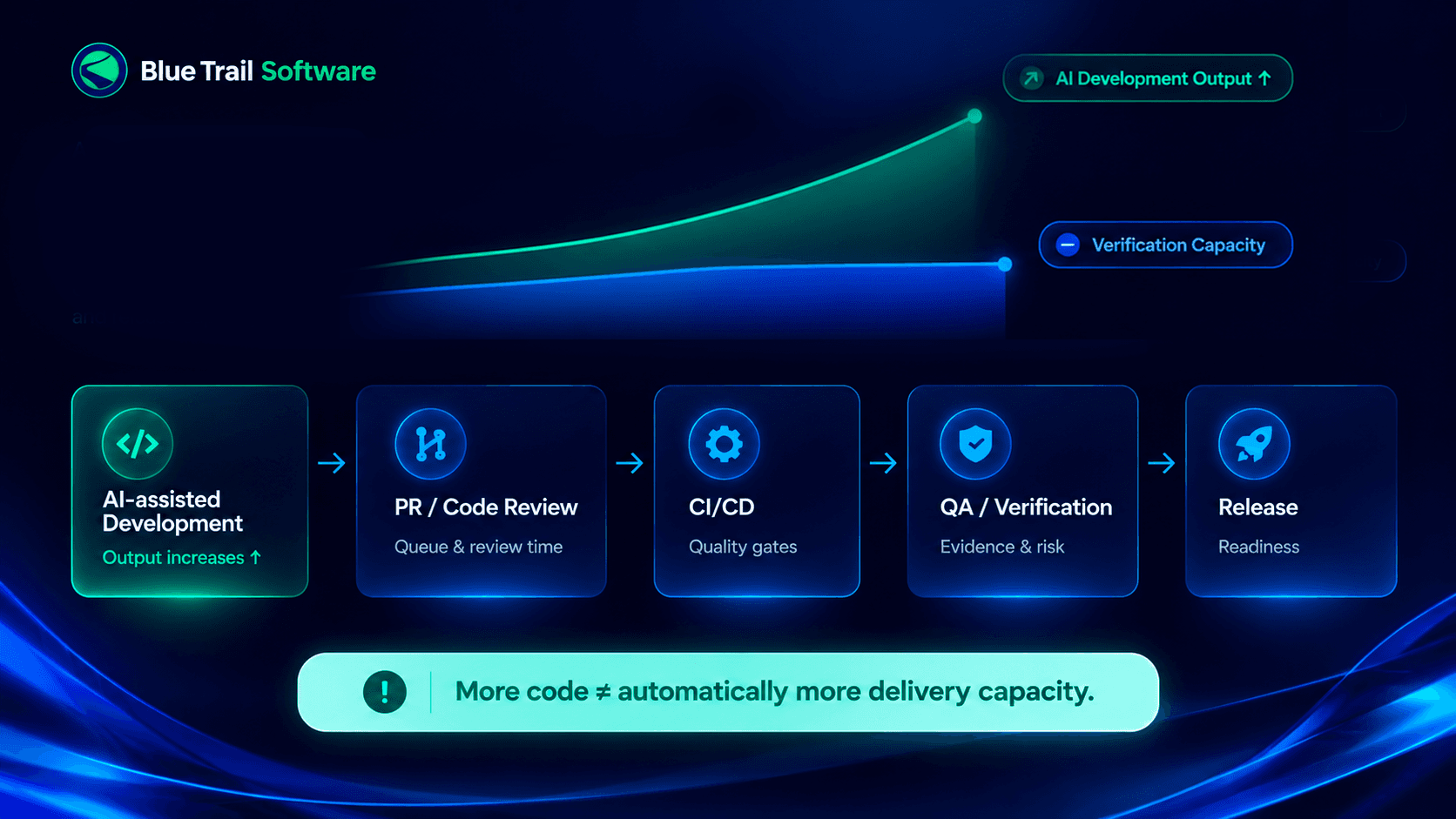
The result: teams may measure how much AI-assisted code they produce without measuring the engineering effort required to verify it.
That is the gap this research explores.
Industry research can tell you the pattern. Your engineering workflow tells you where it hurts.
The AI Verification Gap Report brings together research from developer surveys, organizational research, productivity studies, security research, and large-scale empirical analysis to examine what is changing as AI-assisted development becomes more common.
The report helps engineering leaders ask better questions about:
Review flow
Are AI-assisted changes increasing review effort, waiting time, or rework?
Verification quality
Are your tests and quality gates catching the risks that actually matter?
AI-related risk
Where could AI-assisted changes introduce quality or stability issues that existing controls do not adequately detect?
Engineering outcomes
Is increased AI usage actually improving delivery or simply moving effort into review, testing, debugging, and validation?
The critical question
Where is verification consuming engineering time without providing enough confidence to make the next release decision?
Read The AI Verification Gap ReportThis Is Where Blue Trail Software Comes In.
When verification can't keep pace with AI-assisted development, review delays, noisy quality gates, and hidden rework can erode the delivery gains AI was meant to create. We don't look at verification as a final QA gate. We look at it as part of the engineering system.
Blue Trail Software combines software engineering, AI/GenAI, and QA/testing expertise to investigate verification in the context of the actual development workflow.
Our approach is evidence-driven:
01
Map the flow
Follow changes through development, review, testing, feedback, and release.
02
Test the evidence
Examine verification coverage, review patterns, quality signals, delays, and risk context.
03
Identify the constraint
Determine where verification is consuming time, creating friction, or failing to provide sufficient confidence.
04
Prioritize action
Translate the findings into practical improvements rather than a generic QA checklist.
This is the foundation of the AI Verification Bottleneck Audit.
Find out where verification is actually constraining your delivery.
For engineering organizations already experiencing review delays, CI/CD friction, regression problems, or uncertainty around AI-generated changes, Blue Trail Software offers a focused two-week AI Verification Bottleneck Audit.
The audit investigates your actual engineering environment and available evidence to answer:
Where is verification slowing us down?
Which signals can we trust?
Where are the biggest verification risks?
What should we improve first?
The audit includes:
Verification Workflow Map
How changes move through development, review, testing, and release.
Process Friction Analysis
Where review, testing, validation, or pipeline constraints are creating delays or rework.
PR & CI/CD Findings
Evidence around review flow, quality gates, failure signals, and validation.
AI Code Risk Hotspots
Patterns in AI-assisted changes that warrant further investigation.
AI Engineering Readiness Scorecard
A Blue Trail Software diagnostic view of strengths, gaps, and unknowns across workflow visibility, review flow, quality gates, risk monitoring, and outcomes.
Prioritized Next Steps
A practical view of what to investigate or improve first.
The two-week timeline assumes a defined audit scope and may vary based on the size and complexity of your engineering environment.

Outcome: Don't just know that verification is slowing you down. Know where and what to do about it.
The goal isn't another dashboard or another generic maturity assessment.
It's a clearer answer to:
Where is the constraint? What evidence supports it? What should we change first?
That can help engineering leaders:
Reduce review and validation bottlenecks
Improve confidence in AI-assisted changes
Identify unnecessary verification effort and rework
Strengthen CI/CD quality signals
Understand the relationship between AI adoption and engineering outcomes
Scale AI-assisted development without sacrificing delivery confidence
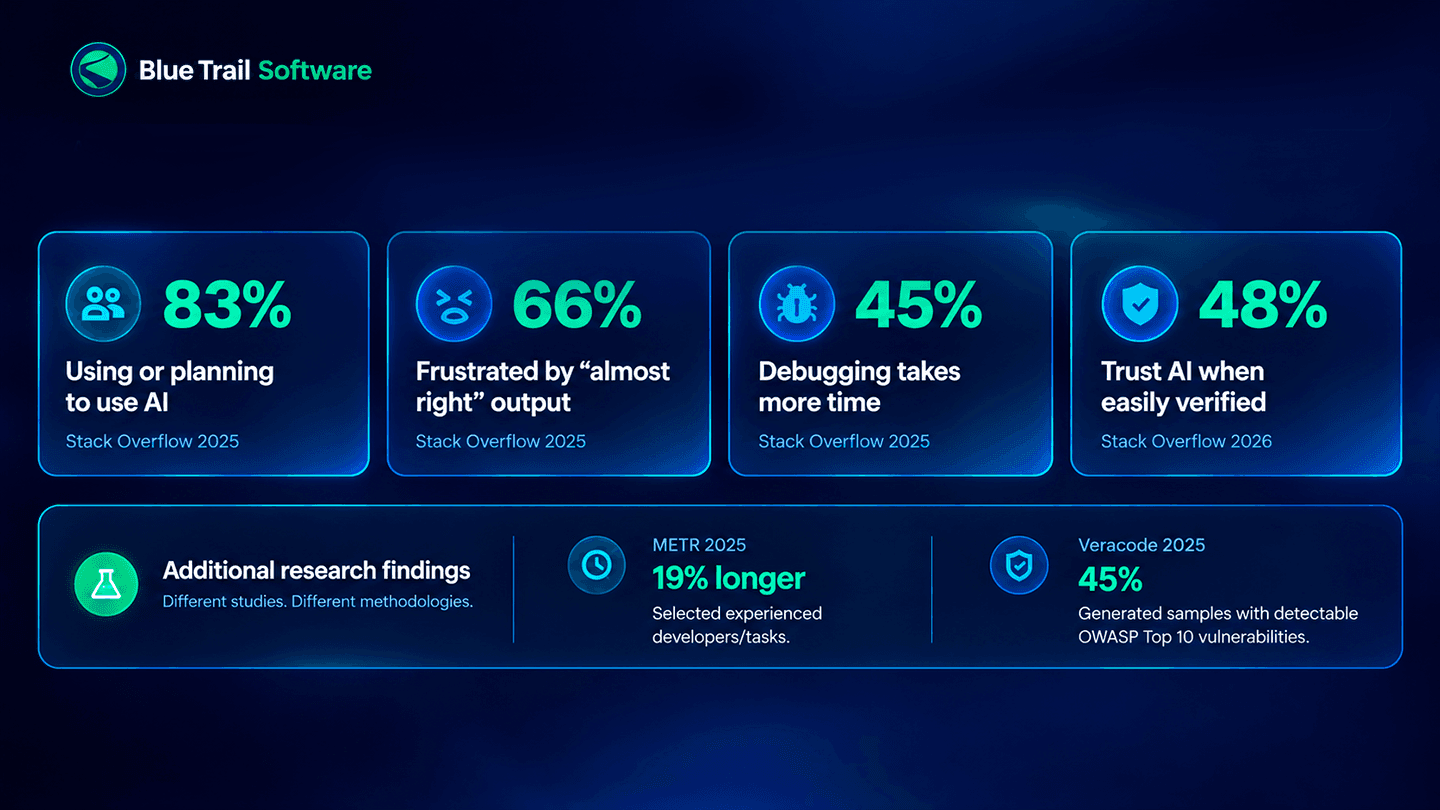
Read The AI Verification Gap Report
Understand the research. Recognize the warning signs. Identify the questions your engineering organization should be asking now.
Read the report
The report is free. No commitment required.